
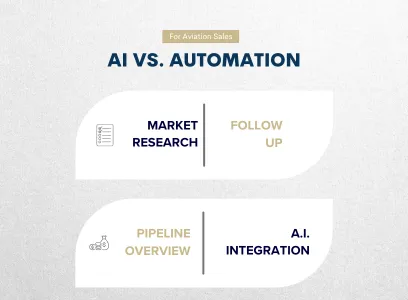
What Every Aviation Business Owners Actually Needs to Know about AI vs Automation
Let's clear something up before we go any further.
AI and automation are not the same thing. Most people use the terms interchangeably, and that confusion is the reason most aviation businesses either do nothing — or invest in the wrong thing and wonder why it didn't stick.
This is the plain-English version of what you actually need to know.
Automation: Rules Without Thinking
Automation is logic-based. You define a trigger and an outcome, and the system executes it every time — without deviation, without judgment, without anyone touching it.
A prospect fills out your contact form → they get an email automatically
A call is logged as "interested" in your CRM → a follow-up task fires for tomorrow
A lead goes 30 days without a response → a re-engagement sequence starts
Automation is reliable, fast, and infinitely repeatable. It does not get tired. It does not forget. But it cannot handle anything outside the script. Give it a scenario you did not pre-program and it either breaks or does nothing.
AI: Judgment at Scale
AI can interpret. Instead of following a fixed rule, an AI model reads context, weighs options, and produces an output based on what it understands — the same way a smart team member does, but at machine speed.
AI can read an inbound email and determine whether it is a sales lead, a service complaint, or a vendor solicitation — and route it accordingly. It can review a prospect list and identify which contacts match your ideal client profile. It can draft follow-up copy that sounds like you wrote it.
Why They Work Better Together
Automation handles the execution. AI handles the judgment. Together, they create something neither can do alone: a system that makes decisions and takes action — without a human managing every step.
AI decides which prospects need follow-up. Automation sends it. AI identifies a lead going cold. Automation fires the re-engagement sequence. The combination is where real leverage lives.
The Three Levels of AI Adoption
Not every business is ready for the same level of AI. Here's how the progression works — and where most aviation businesses currently sit.
Level 1 — Conversational AI
You talk to it. It responds.
ChatGPT, Claude, Gemini. You type a question, you get an answer. Useful for drafting emails, summarizing documents, brainstorming. This is where most people start — and unfortunately, where most people stop.
If you're using AI occasionally for one-off tasks and nothing in your operation has changed, you're at Level 1.
Level 1.2 - if you save conversations or "projects" within your Chat so that your conversations have context and can learn from chat to chat.
Level 2 — Automation AI
You build it once. It runs without you.
This is where AI stops being a tool you use and starts being a system that works for you. Leads get followed up automatically. CRM dispositions trigger the next action. Your prospect list gets enriched without anyone manually copying data between platforms.
The critical difference: Level 2 keeps running when you're in the cockpit, in a client meeting, or just trying to run your business. It doesn't wait for you to open a tab.
Common tools: Make, Zapier, IDENT Platform, HubSpot sequences, Apollo.io
Level 3 — Agentic AI
You hand it a problem. It finds the solution.
This is the frontier. Agentic AI doesn't wait for instructions. You give it a goal — find the top 20 charter prospects in the Southeast, research them, draft outreach, flag the five most likely to convert — and it executes the entire workflow independently, reporting back with results.
Most businesses aren't here yet. But the ones building toward it now will have a significant head start within 18 months.
What This Looks Like in a Real Aviation Business
Theory is useful. Real numbers are better.
LD Aviation Services came to us with 800 purchased contacts, a basic HubSpot setup, and no outbound infrastructure. The owner was running day-to-day operations, her team didn't have bandwidth for a tech buildout, and her tools — Apollo, HubSpot, and a separate calendar — didn't talk to each other.
We weren't brought in for a massive transformation. We were brought in to run a focused pilot program: clean the data, build the automation, produce measurable output.
What we built in 90 days:
Apollo.io data enrichment to add phone numbers and validate 800 contacts
ICP audit to cut 800 contacts down to 80 qualified Part 91 targets — more signal, less noise
Full deployment of the IDENT Platform: aviation-first CRM with call logging, pipeline staging, and a script integration built for aviation sales cycles
Voicemail automation: rep leaves a voicemail, system fires a personalized callback email automatically
10-email nurture sequence running automatically for 30 days after any introduction
Live pipeline dashboard with every call logged and every disposition tracked
The results from 80 contacts:
Metric Result:
Context Qualified Introductions 16 — 20% of targeted list (Industry avg: 10–15%)
Email Open Rate 26.19% (Industry avg: 15–21%)
Email Opt-Out Rate 0% (Industry avg: 2–5%)
List Coverage 90% touched or resolved Full list worked in 90 days
Active Prospects 25 in nurture sequences Running automatically
One number worth noting: call volume averaged 6 calls per day against a 20-call target — roughly 30% of planned activity. The infrastructure still produced a 1-in-5 introduction rate. That's what happens when the list is clean, the messaging is calibrated for aviation buyers, and the follow-up runs automatically regardless of how busy the team gets.
The Honest Point About Small Sample Sizes
80 contacts and 90 days is not a massive dataset. That's intentional.
You don't need a massive rollout to start getting real data. What you need is a focused pilot that produces a documented conversion rate, a baseline open rate, and automation that runs without you. That's a data point — a real one, from your actual business, with your actual buyers.
Running on gut instinct is expensive. Running on your own business data is how you close the gap between "I think this is working" and "I know this is working."
The mistake isn't starting small. The mistake is not starting.
Three Questions Worth Asking About Your Operation Today
What manual tasks does your team repeat weekly that follow a predictable pattern?
When a prospect goes quiet, does anyone follow up automatically — or does it depend on someone remembering?
Do your tools talk to each other, or does data move between them manually?
If the honest answer to any of these is "we do that manually" — there is an automation opportunity sitting in your operation right now. It's not a six-month project. It's not a developer hire. It's identifying the first two or three workflows worth automating and building from there.
Ready to Find Your Low-Hanging Fruit?
Book a free discovery call with the AvSales Talent team. We'll walk through your current systems, identify where manual work is costing you time and revenue, and show you what Level 2 operation looks like configured specifically for your aviation business.
No obligation. No generic playbook. Aviation-specific, built around how you actually sell.
Schedule your discovery call → https://engine.avsalesident.com/widget/bookings/ident